Written by BLOCKv Foundation
It all started back in 2017, when we introduced the first-ever NFT platform and technology of programmable objects. Real adoption came only a few months later, followed by our successful TGE for the token that powers the protocol to this day.
Over the years, BLOCKv has worked with over 100 different companies, either directly or through leading integration partners such as SmartMedia Technologies, which built its enterprise Web3 platform on top of the BLOCKv Web3 OS. Through these partnerships, BLOCKv technology has reached companies like VISA, PepsiCo, Unilever, the Olympics, and countless more.
But BLOCKv was never meant to be limited to consumer engagement experiences and loyalty. We built the technology as a tokenization platform for everything, from immersive experiences and loyalty programs to real-world assets, tokenized stocks, commodities, digital twins for luxury items, and far beyond.
Since earlier this year, we've been talking about how we want to open this platform and fully decentralize it. We want our community to participate with increased governance and power to the token, and to build entirely new experiences on top of the stack.
Our goal: ensure BLOCKv becomes not only the most widely adopted Web3 operating system for enterprises, but also one of the most widely adopted Web3 protocols for all tokenized real-world-asset use-cases.
New Decentralized Infrastructure
The current BLOCKv Network has been running for years, processing millions of transactions for enterprise clients. It was purpose-built for enterprise onboarding, and it has delivered. Now we're building the next layer: an open protocol where anyone can build, where the community participates in validation, where decentralization is the actual design.
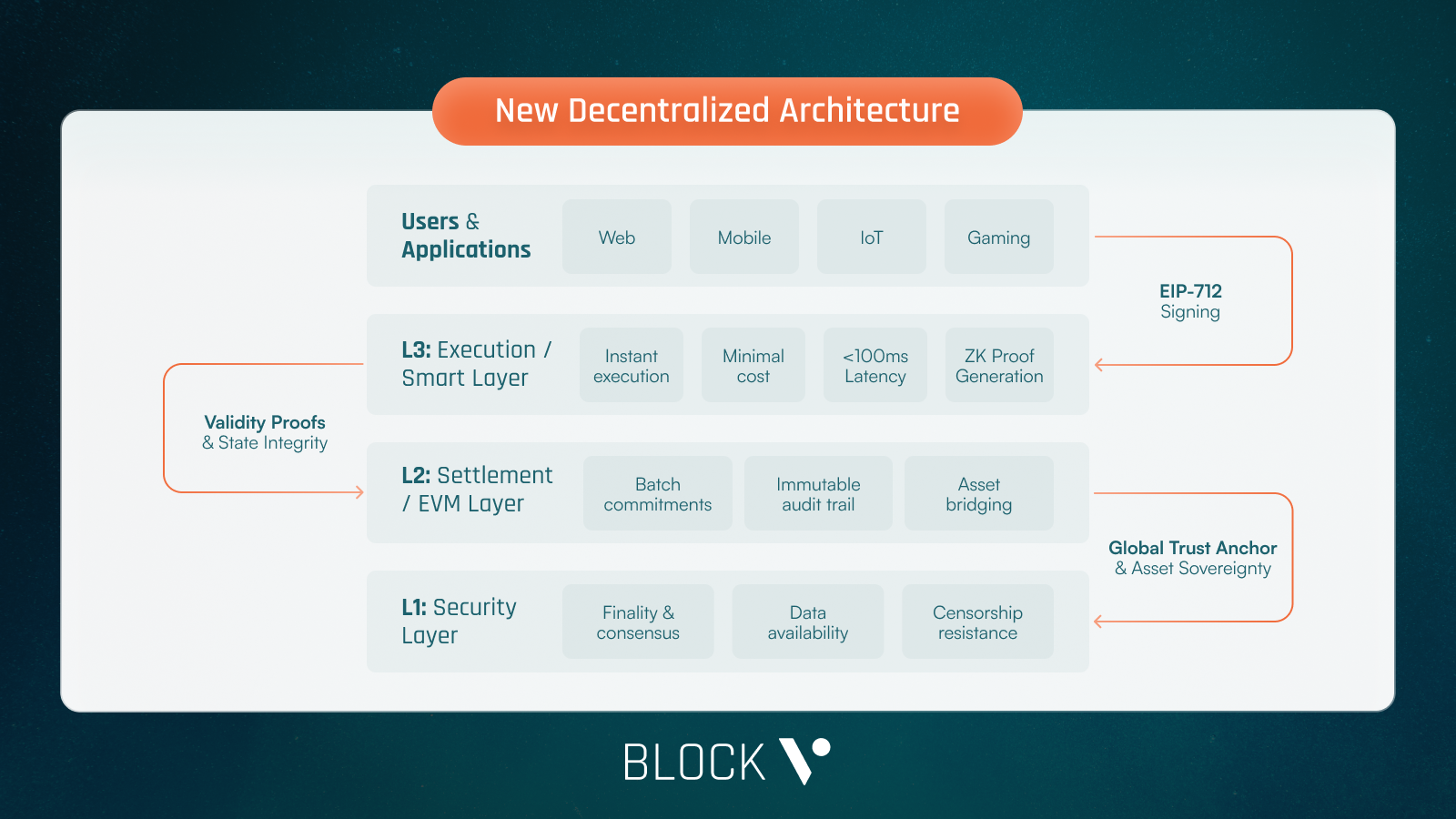
We've rebuilt the technical foundation from scratch. The new BLOCKv launches as a full Layer 2 blockchain on Ethereum, powered by our native token for gas. Not a sidechain with its own security assumptions. Not a separate network connected by a bridge that could be exploited. A proper L2 that inherits Ethereum's security directly: every transaction, every state change, cryptographically verified to Ethereum mainnet through rollup proofs.
Why L2 instead of continuing with our own L1? Because security isn't something you can bootstrap with a small validator set and promises about future decentralization. Ethereum has years of battle-testing, hundreds of billions in economic security, and the institutional trust that comes from being the settlement layer for serious financial infrastructure. When enterprises tokenize assets worth millions of dollars, they need that foundation. When users stake tokens, they need to know the network can't be attacked by someone with enough capital to bribe a handful of validators.
On top of the L2, we're running an L3 application layer that handles the high-throughput operations enterprises actually need. Minting millions of loyalty tokens during a campaign. Processing real-time transfers for event ticketing. Managing digital product passports across global supply chains. This L3 layer handles the volume while writing cryptographic proofs down to the L2, which rolls everything up to Ethereum.
The infrastructure is already running on testnet. The deployment is live, and we're testing it now and preparing for mainnet launch.
Brand New Identity
BLOCKv built its reputation through pioneering work in programmable digital objects (AR experiences, collectible campaigns, and loyalty programs) that onboarded millions of users and proved the technology could work at scale.
The platform has since expanded far beyond those use cases. We're tokenizing real-world assets. We're building digital product passports for designer brands and manufacturers. We're working with partners on tokenized commodities, stablecoins, and institutional-grade infrastructure. The platform now handles compliance requirements, integrates with traditional financial systems, and processes millions of transactions for Fortune 500 companies.
It's time for the brand to reflect that evolution. We're launching under a new name with a completely new visual identity. New website, new token, new documentation, new everything. This isn't a logo refresh, it's a full reset designed for the next decade of what this platform becomes.
The original BLOCKv name was built around virtual objects on blockchains, digital representations of physical things. That core concept hasn't changed, but we've found a name that captures the same idea more directly: the relationship between physical and digital, real and virtual, the asset and its on-chain representation. Same vision, now positioned to serve both enterprise clients and the broader Web3 ecosystem.
When we release, everything goes live at once. New brand, new L2, new token, migration tools, updated exchange listings.
Importance of the BLOCKv Token
We’re upgrading our VEE token to unlock the full potential of this next phase: real‑world assets at scale, deeply integrated with our new L2/L3 architecture, and a much stronger alignment of value between users, developers, the community, and the network.
The upgrade introduces a new contract, a new name, and a design that’s tightly coupled with our new decentralized infrastructure, enabling native staking, fee distribution, and governance in a way the current token wasn’t built for, alongside restructured tokenomics designed to power staking, reward participation, and support long‑term growth.
As part of the upgrade, the total supply will increase over the next 5 years on avarage by 6.5% per year. The additional supply is released gradually over five years, dedicated to ecosystem growth, governed by the DAO: Foundation initiatives that expand usage and adoption, and staking rewards that incentivize long‑term holders and drive further decentralization of the network.
The token will launch natively on our chain, as well as Ethereum and Base, with more chains to follow in the future. We chose Base alongside Ethereum because it offers low fees and strong infrastructure, making the token accessible to users who don't want to pay Ethereum mainnet gas costs for smaller transactions.
Current VEE holders can upgrade their tokens with a single click.
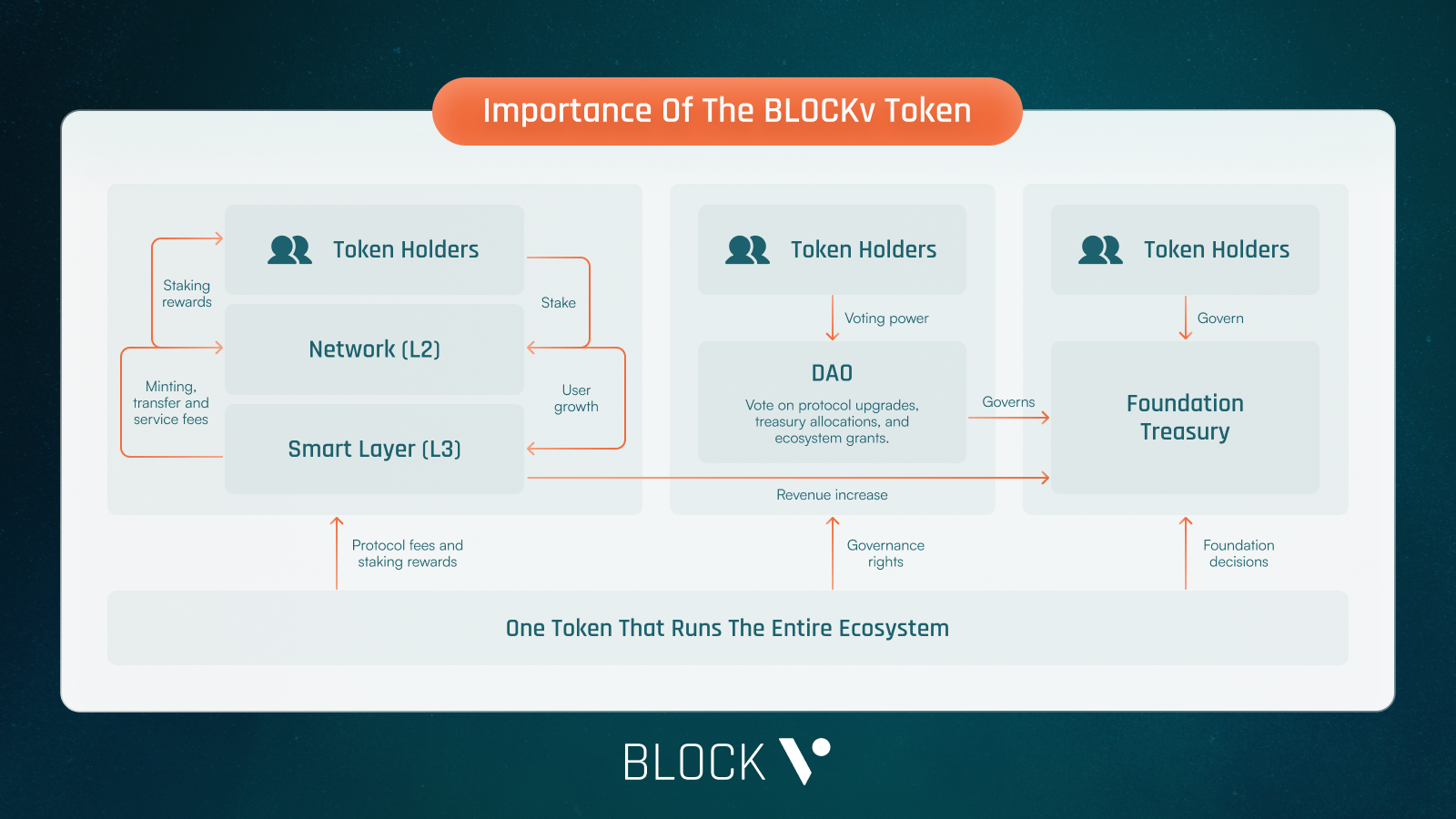
▪ Staking secures the network. When you stake, your tokens help validate operations on the L2. In return, you can earn from protocol fees generated across the platform, minting fees, transfer fees, service fees. As network usage grows, staking rewards grow. The mechanism is simple: usage generates fees, fees go to stakers. With an added bonus token allocation, to incentivize users to stake their tokens and contribute to larger decentralization.
▪ Gas fees on the L2 network. Every on-chain transaction on our L2 (token mints, transfers, smart contract interactions, digital asset operations), requires the token as gas. This creates consistent demand directly tied to network activity. The more the network, the more tokens are required for gas. As our L2 evolves into a broader RWA chain with third-party developers building dApps on top of the infrastructure, gas demand expands beyond our platform to every application deployed on the network.
▪ Governance launches on day one. We're deploying on-chain DAO governance. Token holders can vote on protocol upgrades, treasury allocations, and ecosystem grants.
▪ One token runs the entire system. Protocol fees are paid in the token. Staking rewards are distributed in the token. Governance rights come from holding the token. Key Foundation decisions are made by token holders. Single economy, single asset, multiple chains.
Migration is one transaction. Burn your old tokens, receive new tokens in the same wallet. We're keeping the window open for two years so nobody gets rushed.
The token supply comes from the migration pool and structured ecosystem reserves. Current holders migrate their positions.
Expanded Use Cases
The enterprise work over the past years was research and development at scale, real-world implementations with demanding clients pushing the infrastructure to its limits. Every integration taught us something about what tokenization actually needs to do in production environments.
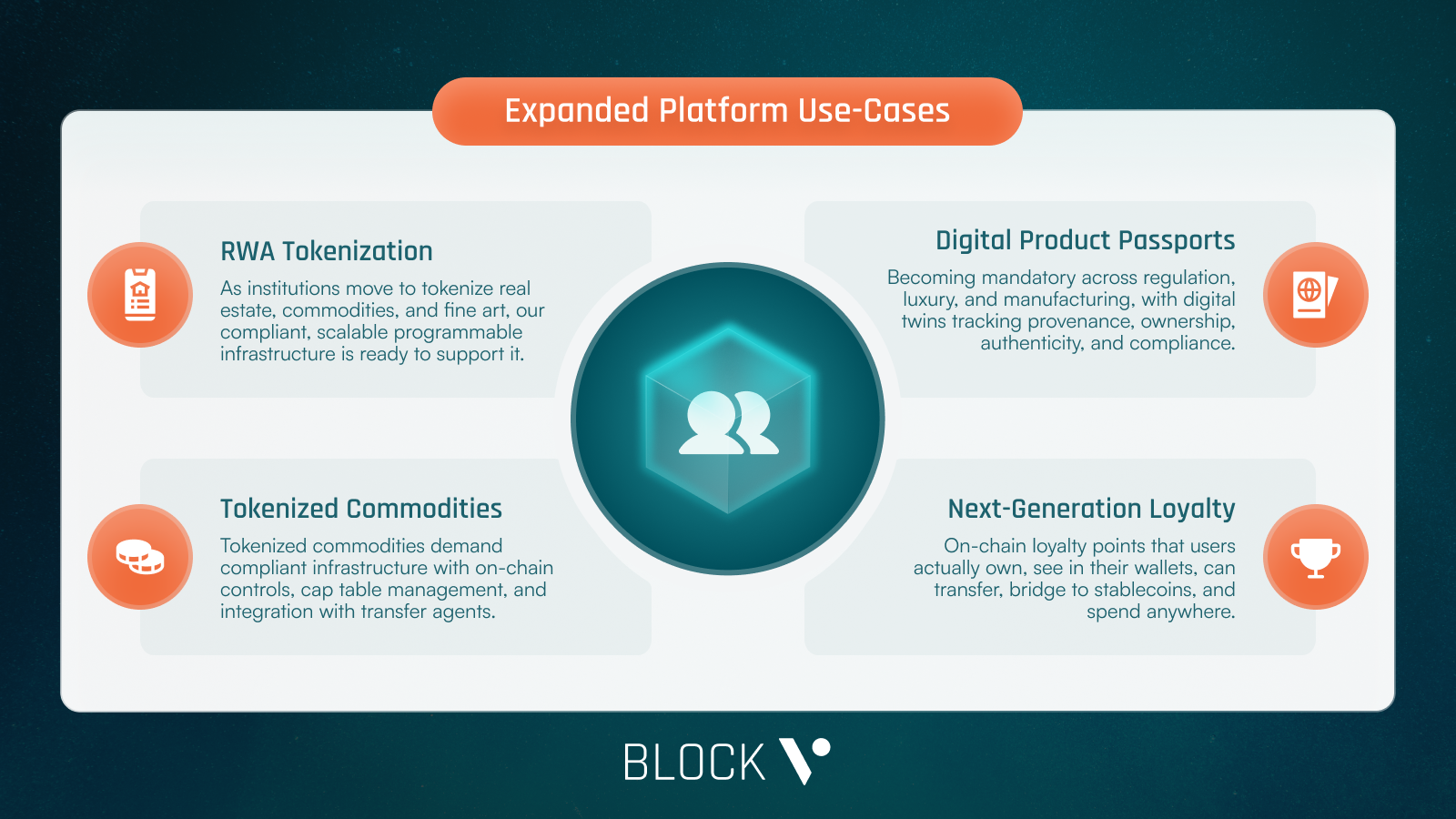
Real-world asset tokenization is the obvious one. We've been tokenizing things for years, loyalty points, collectibles, tickets, certificates. Now there's an industry narrative around RWA and billions in institutional capital looking for infrastructure to tokenize everything from real estate to commodities to fine art. Our infrastructure was built for exactly this. Compliant token issuance, programmable transfer restrictions, on-chain audit trails, integration with traditional custody and settlement systems. The institutional RWA wave is coming to infrastructure we already built.
Digital product passports are becoming a regulatory requirement in multiple jurisdictions. The EU is mandating them for certain product categories. Luxury brands want them to fight counterfeiting. Manufacturers need them for supply chain compliance. Every physical product gets a digital twin that tracks provenance, ownership history, authenticity, and compliance data. We've been building this for years with enterprise clients. The regulatory tailwind is just starting.
Next-generation loyalty infrastructure is already in production with our enterprise clients. Forget closed-loop points that expire and can only be redeemed in one place. On-chain loyalty points that users actually own, can transfer, can bridge to stablecoins if they want to cash out. Clients of SmartMedia Technologies are running this now. Users earn points, see them in their wallet, bridge them to stablecoins and spend them anywhere. Loyalty programs that aren't walled gardens, that's what's possible with proper tokenization infrastructure.
We built horizontal infrastructure that can handle all of these use cases.
AI-First Web3 Developer Platform
AI integration is becoming essential across blockchain infrastructure. We're building it into the core of our platform because it genuinely enhances the possibilities of what can be done.
Tokenization involves a lot of repetitive operations. Deploying token contracts and business logic. Configuring parameters. Setting up compliance rules. Managing minting and distribution. These are tasks that can be described in natural language and executed by AI agents, if the infrastructure supports it.
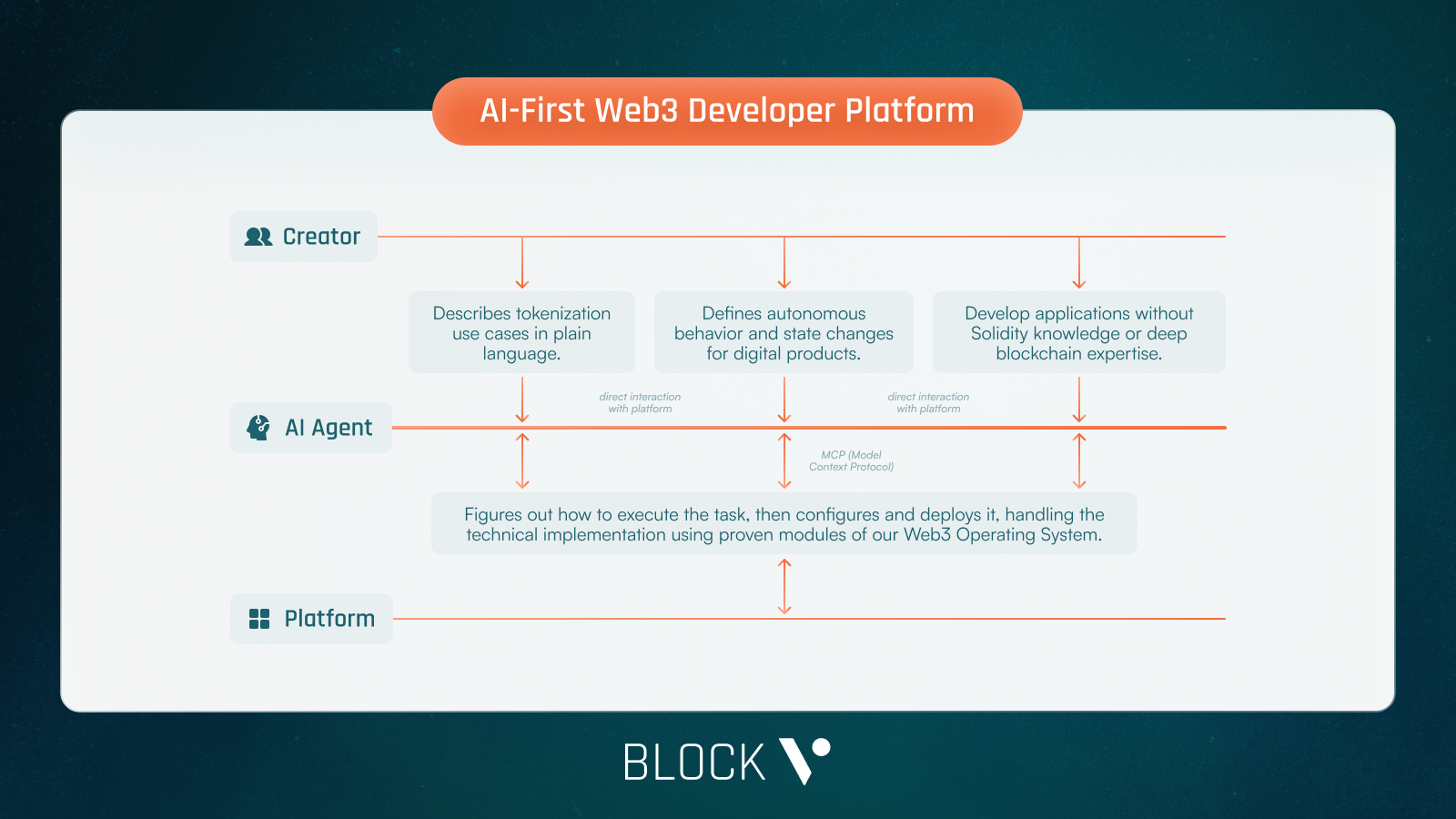
We've built MCP (Model Context Protocol) servers that let AI agents interact directly with the tokenization platform. An AI can mint tokens, check balances, execute transfers, deploy new token templates, manage permissions. Not through screen scraping or hacky API wrappers, but through native integration that treats AI agents as first-class users of the system.
What does this mean in practice?
You can describe a tokenization use case in plain language and have an AI agent configure and deploy it. "Create a redeemable reward token for my brand with 1 million supply, set up a rule that the reward expires after 12 months if not redeemed, and mint it on Base." The AI handles the technical implementation using the proven modules of our Web3 Operating System, not a potentially vulnerable code.
Tokens can have autonomous behaviors. A digital product passport that automatically updates its status based on supply chain events. A loyalty token that adjusts its exchange rate based on market conditions. Assets that respond to real-world data without requiring manual intervention.
Development becomes accessible to non-technical users. Building on our platform shouldn't require deep Solidity knowledge or understanding of blockchain infrastructure details. Describe what you want, the AI figures out how to build it.
The intersection of autonomous AI and programmable assets is where this industry is headed. We're building the infrastructure layer for that future.
What Comes Next
We've spent years focused on enterprise delivery, work that, by its nature, happens before public announcements. That focus built the foundation we're now ready to open up.
A decentralized protocol with community governance requires transparent development. Stakers and token holders need to know what's being built. Developers considering the platform need visibility into the roadmap. We are committed to transparent development updates and communication about what we're building.
We are releasing very soon. New name and brand identity. New L2 infrastructure live on testnet with mainnet date. New token with clear migration path. Updated exchange listings. Full documentation.
If you've been with us since the early days, you've seen the technology mature and the enterprise traction build. Now you'll see the protocol open up for broader participation.
If you're just discovering us now, you're arriving as the platform enters its most ambitious phase yet.